Implementing relational multi-disciplinary public services
How to develop relational public services with local multi-disciplinary teams using a rapid test and learn approach. Designing-in prevention in our localities and local neighbourhoods .
What is a relational service?
Multi-disciplinary front line staff, working collaboratively to deal with the complexity are designed to operate 'liberated' from the constraints of our functional processes, they are designed within decision-making frameworks to enable them to have the right level of flexibility and control.
- Staff have the authority to enable the right decisions to be made, allowing staff to directly work with the needs of the person rather than simply following a rigid process.
- Teams doing the right thing, focusing on value work, minimising bureaucracy and cost.
- Enabling better outcomes by focusing on the real causes rather than the immediate problems, reducing repeat demand.
- Staff collaborative with others and become more effective, boosting productivity.
- Staff become motivated to contribute to helping people, and learn how to do it well, crating teams that want to work together.
- Staff have the authority to enable the right decisions to be made, allowing staff to directly work with the needs of the person rather than simply following a rigid process.
- Teams doing the right thing, focusing on value work, minimising bureaucracy and cost.
- Enabling better outcomes by focusing on the real causes rather than the immediate problems, reducing repeat demand.
- Staff collaborative with others and become more effective, boosting productivity.
- Staff become motivated to contribute to helping people, and learn how to do it well, crating teams that want to work together.
What a relational service looks like
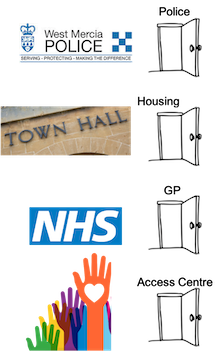
Liberating staff to create value leads to an approach that represents what public service is meant to be about. But somehow we often fail to achieve this through the current ways of working and designing digital services. Austerity and departmental service design can push people in need to have to go through various different 'front doors' to try and get support. We have found that this functional design is one of the causes of the rift between the public sector, people and communities, and the causes of bureaucracy. Then, when we try and collaborate together, we often find barriers that prevent real innovation and learning from occurring.
By acting flexibly, front line teams develop new relational ways of working by working within agreed frameworks that are different of the standards that are currently the norm in the organisation. It is about designing services flexibly so that they allow for the complexity of the causes of peoples issues in their lives to be understood and then acted on - identifying what is preventing them from living a good life. It is less about doing things for people, but more about working with people so that they can pull themselves back from the issues they are facing, and get further support within their communities.
By acting flexibly, front line teams develop new relational ways of working by working within agreed frameworks that are different of the standards that are currently the norm in the organisation. It is about designing services flexibly so that they allow for the complexity of the causes of peoples issues in their lives to be understood and then acted on - identifying what is preventing them from living a good life. It is less about doing things for people, but more about working with people so that they can pull themselves back from the issues they are facing, and get further support within their communities.
A typical operational sequence of this approach might look like this:
Step 1 Understand - A team member will start by understanding a person in the context of their life, their family and their community. This usually takes place face to face, and it may occur in their home.
Step 2 Context - That then uncovers the context and causes of why they are in that situation. This might be starting from a problem that is identified of someone who cannot pay their council tax, and we discover that they have multiple problems with their family life and employment.
Step 3 Explore - they will explore together what actions would make the greatest impact for that person that helps them back to a balance in their lives. This might involve connecting them with others that can help them clean up their apartment, get some activities for the children, and begin to find new employment.
Step 4 Ownership - This continues, and as the person regains balance, their ability to pay their debts is an outcome of that re-balance. The majority of the activity needed are often enabling activities. The role of the team is one of coordination. In our work there have been many transformations in peoples lives simply from two or three conversations, so this is not about spending time or hand-holding. This is about understanding and reframing their situation with them, and is often performed by people who have no particular expertise in care - often team members are from customer services.
Step 1 Understand - A team member will start by understanding a person in the context of their life, their family and their community. This usually takes place face to face, and it may occur in their home.
Step 2 Context - That then uncovers the context and causes of why they are in that situation. This might be starting from a problem that is identified of someone who cannot pay their council tax, and we discover that they have multiple problems with their family life and employment.
Step 3 Explore - they will explore together what actions would make the greatest impact for that person that helps them back to a balance in their lives. This might involve connecting them with others that can help them clean up their apartment, get some activities for the children, and begin to find new employment.
Step 4 Ownership - This continues, and as the person regains balance, their ability to pay their debts is an outcome of that re-balance. The majority of the activity needed are often enabling activities. The role of the team is one of coordination. In our work there have been many transformations in peoples lives simply from two or three conversations, so this is not about spending time or hand-holding. This is about understanding and reframing their situation with them, and is often performed by people who have no particular expertise in care - often team members are from customer services.
The impact
Evidence based examples that we have been involved in have shown that this way of working pushes all indicators in the right direction; peoples begin to have less dependancy on the public sector, costs reduce and demand stops spiralling upwards.
At a place based locality level
Working in this new relational way allows for the outcomes of people to improve through enabling the strengths in their families and communities.
Value and failure demand is a powerful method to understand the impact of poor design. In the locality team, when we worked with tenants who were experiencing difficulties and had significant problems that caused them repeated visits to various public sector agencies:
the number in this situation dropped from 27 to 13 over a period of 6 months.
The resources used began to drop as this way of working became embedded, creating a drop in resourcing of 15 - 30%
At a place based locality level
Working in this new relational way allows for the outcomes of people to improve through enabling the strengths in their families and communities.
Value and failure demand is a powerful method to understand the impact of poor design. In the locality team, when we worked with tenants who were experiencing difficulties and had significant problems that caused them repeated visits to various public sector agencies:
the number in this situation dropped from 27 to 13 over a period of 6 months.
The resources used began to drop as this way of working became embedded, creating a drop in resourcing of 15 - 30%
failure demand of multiple front doors
At an individual level
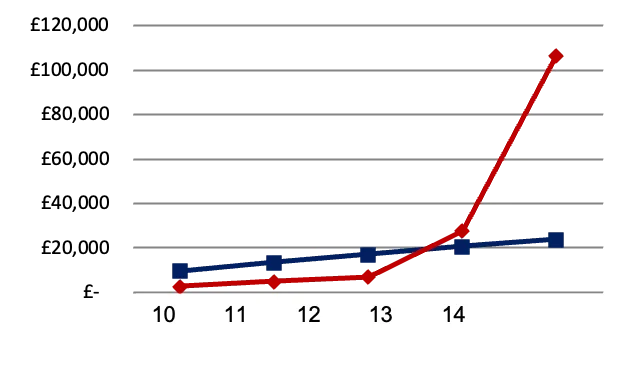
In this other example, of a person with increasing problems as their children got older, the RED line demonstrates the real cost of simply taking short term actions, applying our standard solutions, and not dealing with the causes of problems. Compare this to the BLUE line that has a slightly increased cost at the start, and the reduction in the longer term cost.
In this other example, of a person with increasing problems as their children got older, the RED line demonstrates the real cost of simply taking short term actions, applying our standard solutions, and not dealing with the causes of problems. Compare this to the BLUE line that has a slightly increased cost at the start, and the reduction in the longer term cost.
comparison of the current vs relational service
Changes within the organisation & the workforce
The significant change occurs within the team. They become engaged, motivated, and therefore personally committed to make this approach work. The managers leading the team adapt their behaviours and methods to connect closer to the team in ways that open up managers roles to be more supportive, less bureaucratic, and therefore more rewarding.
Recording, meetings and paperwork decreases, and time engaging with people increases.
The functions in the organisation behind this work ultimately shift into supporting this relational work, rather than being a burden.
The way that measures are used shift from compliance, to learn and improve.
The significant change occurs within the team. They become engaged, motivated, and therefore personally committed to make this approach work. The managers leading the team adapt their behaviours and methods to connect closer to the team in ways that open up managers roles to be more supportive, less bureaucratic, and therefore more rewarding.
Recording, meetings and paperwork decreases, and time engaging with people increases.
The functions in the organisation behind this work ultimately shift into supporting this relational work, rather than being a burden.
The way that measures are used shift from compliance, to learn and improve.
Lets hear directly from John, who has been working in a relational team, as he describes how it has changed him and his work
Test and learn principles & concepts
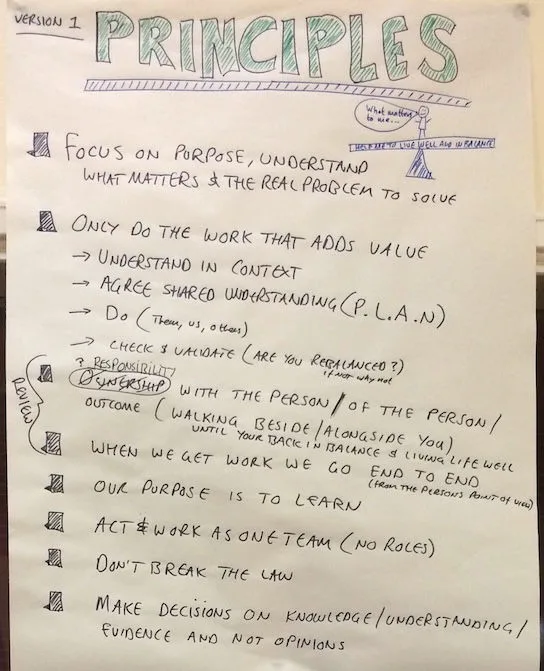
The teams are guided by a set of common agreed operational principles that are the core of the new way of working, using test and learn concepts.
The list has come from systems thinking, been honed by successful teams over many such transformations, and variations are used as the foundation of activity and decision making. It drives a common purpose and approach, that then informs the strategic mission of the service.
The list has come from systems thinking, been honed by successful teams over many such transformations, and variations are used as the foundation of activity and decision making. It drives a common purpose and approach, that then informs the strategic mission of the service.
- Understand what matters for each person in their context.
- Decide and share together what actions to take, enabling the person to gain control of their journey back to a good life.
- Only do and record what is needed to create value.
- We make decisions based on knowledge and evidence, not opinion or standards.
- Take ownership through the end to end journey with the person.
- Work as a team, without department barriers, enabling each others strengths.
- Our ethos is to support each other, learn and improve.
Rule 1 - do not break the law.
Rule 2 - we do not make a persons situation worse.
- Decide and share together what actions to take, enabling the person to gain control of their journey back to a good life.
- Only do and record what is needed to create value.
- We make decisions based on knowledge and evidence, not opinion or standards.
- Take ownership through the end to end journey with the person.
- Work as a team, without department barriers, enabling each others strengths.
- Our ethos is to support each other, learn and improve.
Rule 1 - do not break the law.
Rule 2 - we do not make a persons situation worse.
typical relational service principles
"Help me to take back control of my life, and learn how to use those around me and my community to do that"
By using these principles shifts in the power base of control occurs, so that the organisation and the person engage in a trust based supportive relationship. Power with, rather than power over. It uncovers the real needs and potential solutions that can support the person. It allows for different experts to work together for a common purpose. It ultimately creates a new way of working.
All of this is underpinned by groups like Human Learning Systems, where we have been putting together the theories and research behind this work.
All of this is underpinned by groups like Human Learning Systems, where we have been putting together the theories and research behind this work.
The characteristics of this test and learn way of working
- Understanding a person in the context of their life and how they have got to where they have drive the activities of the team. The team is driven by this purpose as derived by the customer.
- Relational working drives functional barriers and failure demand within the organisation to be dismantled.
- The work flow occurs in such a way as to minimise the cost of doing the work to the organisation.
- Participation automatically occurs between departments and people - collaborative teams form as they need to.
- Many operational decisions are made within the work activities, with more complex decisions being escalated.
- Employee motivation and work life becomes positive at an individual level.
- Ownership and knowledge develops over time, enabling expertise to develop.
- Measures are used to learn and improve.
At the core of this method is a strength based approach, that has implications for both the person that needs support, and the organisation. The manager has a key role to play, who now learns how to work with the team so that the ability of each employee is developed to the full and they get the support they need. Managers focus on minimising barriers to this way of working, and ensures that the team communicates and works together effectively. Managing is more about supporting and developing, rather than instructing and auditing.
Implementing the practice, making this work
A self-managed team environment does not just happen, it is a significant shift and it needs to be developed with a team. Then, when it's created, it needs support to improve and grow. Relational working is not easy, especially when there will be some who are so engrained in the current way of working that they simply find this way of working too different. It's the manager as a leader that must be the creator of this way of working.
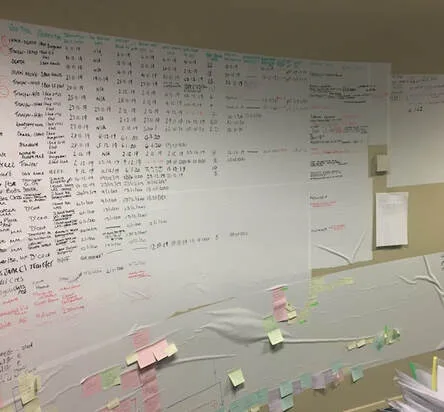
It requires an implementation method, and the learning from the experience of those that have done this many times, learning from success and well as the many times that it did not work so well.
Above, I created a video that explains more about the 'test and learn' concepts behind this method.
It requires an implementation method, and the learning from the experience of those that have done this many times, learning from success and well as the many times that it did not work so well.
Above, I created a video that explains more about the 'test and learn' concepts behind this method.
the test & learn room
How we can help you
We have the skills and experience to:
- set up the team with the best participants,
- involve key people from the organisation in the right way to be supportive
- link decision-makers to the team directly, becoming part of a wider team,
- take the team through activities where they learn the new methods that they need,
- set up the team with the best participants,
- involve key people from the organisation in the right way to be supportive
- link decision-makers to the team directly, becoming part of a wider team,
- take the team through activities where they learn the new methods that they need,
- facilitate the team to develop to work on their own,
- create and record artefacts, records, and progress,
- develop the team into a working team with a new culture,
- create new measures and measure outcomes.
Our 21 years experience
We are asked to support organisations in two ways;
- we have developed expertise where we can guide you in redesigning your services and how you work together
- we can help your internal consultants do this for themselves through workshops and virtual mentoring.
The expertise that we have gained helps you to avoid the significant design issues and operational pitfalls associated with such implementation. With this type of complex change, we have found that those that have struggled to do this are far more common than those that have succeeded.
We have led or participated in:
- 5 locality hubs.
- 2 health and social care prototypes
- 29 service redesigns
- research and methods from Human Learning Systems and other methodologies.
Our work and this website is based on this approach since 2003. We have been trained and have been working with the originator of these concepts, John Seddon, for 11 years.
- we have developed expertise where we can guide you in redesigning your services and how you work together
- we can help your internal consultants do this for themselves through workshops and virtual mentoring.
The expertise that we have gained helps you to avoid the significant design issues and operational pitfalls associated with such implementation. With this type of complex change, we have found that those that have struggled to do this are far more common than those that have succeeded.
We have led or participated in:
- 5 locality hubs.
- 2 health and social care prototypes
- 29 service redesigns
- research and methods from Human Learning Systems and other methodologies.
Our work and this website is based on this approach since 2003. We have been trained and have been working with the originator of these concepts, John Seddon, for 11 years.
Helping you to do this
workshops designed to help your internal consultants gain key methods, and learn from our expertise
Free resources to help you to do this
Examples & case studies
Examples from local authorities, place based and an ICS prototype
A description of how we can experiment, test and learn, to come up with relational working.
An example of relational working in action
Example of the old system:
A person lacking money, and has housing problems, has been known to steal to get by, and get into trouble with the police. They continually are in difficulties with their landlord and the housing they are in. To get help they go to separate services, repeating their immediate issues to each service. Individual actions occur, but no efforts are coordinated, and the real causes are not understood nor are they addressed. And so the persons frustration increases until they become labeled as 'non-compliant' or difficult.
The result is a cycle of misuse, police activity, and plenty of work for housing officers. Costs, over the years rise; typically into the tens or hundreds of thousands of pounds.
A person lacking money, and has housing problems, has been known to steal to get by, and get into trouble with the police. They continually are in difficulties with their landlord and the housing they are in. To get help they go to separate services, repeating their immediate issues to each service. Individual actions occur, but no efforts are coordinated, and the real causes are not understood nor are they addressed. And so the persons frustration increases until they become labeled as 'non-compliant' or difficult.
The result is a cycle of misuse, police activity, and plenty of work for housing officers. Costs, over the years rise; typically into the tens or hundreds of thousands of pounds.
Example of relational working:
That person is able to describe their history over the past years to be eventually understood in the totality of their lives, together with what makes them behave the way they do. What that person needs to begin their journey to sort themselves out are uncovered, and we begin to enable those things to happen across the voluntary and public sector.
The result is coordinated activity across different public sector services that is led by one member of staff, where the person begins to see possibilities of resuming a normal life. Costs eventually reduce as they sort themselves out, and they begin to look for work.
That person is able to describe their history over the past years to be eventually understood in the totality of their lives, together with what makes them behave the way they do. What that person needs to begin their journey to sort themselves out are uncovered, and we begin to enable those things to happen across the voluntary and public sector.
The result is coordinated activity across different public sector services that is led by one member of staff, where the person begins to see possibilities of resuming a normal life. Costs eventually reduce as they sort themselves out, and they begin to look for work.